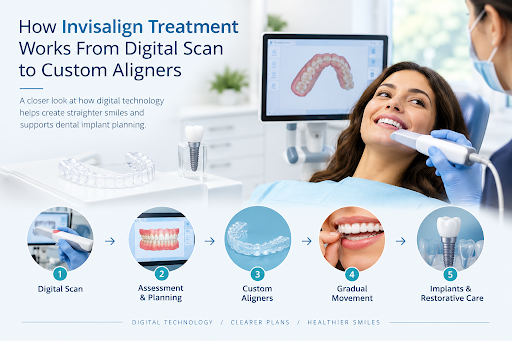
A straighter smile can involve much more than simply wearing clear trays. Modern dentistry uses digital technology to understand the position of your teeth, plan the movement required, and create a treatment approach suited to your individual needs. Invisalign treatment follows this digital approach, using clear, removable aligners to gradually move teeth into planned positions. Today, dental clinics can also use advanced scanning technology instead of traditional impressions, making the planning process more convenient and detailed.
What Makes Digital Aligner Planning Different?
Traditional dental impressions involve placing impression material in the mouth to create a physical mould of the teeth. Digital dentistry offers another approach. An intraoral scanner captures detailed images of the teeth and creates a digital representation of the mouth.
The clinic is now fully digital with a Trios intraoral scanner, which can be used to capture the teeth without relying on conventional impression trays. The digital scan can support treatment planning and help patients understand their proposed treatment more clearly.
This technology is particularly useful when planning treatments that require careful attention to the position and relationship of the teeth, including clear aligners and restorative procedures.
Step 1: Your Teeth Are Digitally Scanned
The first stage begins with a dental examination and digital scan. The Trios intraoral scanner captures the surfaces of the teeth and surrounding areas to create a digital model.
The process is straightforward. The scanner is guided around the mouth, capturing images that are combined into a detailed digital model. Unlike a traditional impression, there is no need to wait for a physical mould to set.
The dentist can then review the digital information to understand the current alignment of the teeth and identify areas that may require attention.
Step 2: Your Smile and Bite Are Assessed
A scan is only one part of treatment planning. Your dentist also considers your overall dental condition, bite, and treatment goals before deciding whether clear aligners are suitable.
This assessment is important because teeth do not move independently. Their position is connected to the way the upper and lower teeth meet. A suitable treatment plan therefore needs to consider both tooth alignment and bite.
For patients with missing teeth, the treatment discussion can be different. Dental implants are designed to replace missing teeth using an implant post that integrates with the jawbone and a crown placed over it. Digital scans and other diagnostic information can help the dentist assess implant candidacy alongside clinical examination and X-rays.
Step 3: A Digital Treatment Plan Is Created
Once the dental assessment is complete, the digital information can be used to plan the movement of the teeth. Clear aligner treatment works through a series of trays, with each tray designed to make gradual changes to tooth position.
The digital approach allows the planned sequence of movement to be visualised before the aligners are produced. This gives the dentist a clearer way to assess the proposed treatment and explain the process to the patient.
The clinic is also a certified Invisalign provider, allowing eligible patients to explore Invisalign clear aligners as part of their orthodontic treatment.
Step 4: Your Custom Aligners Are Made
Unlike a standard mouthguard, clear aligners are designed around the individual patient’s teeth and treatment plan. A series of custom aligners is produced to guide the teeth gradually.
Each aligner is generally worn for around one to two weeks before moving to the next one, depending on the treatment plan. The aligners are removable, which makes it possible to take them out while eating and during regular brushing and flossing.
For effective treatment, patients need to follow their dentist’s instructions and wear the aligners for the recommended amount of time each day.
Step 5: Your Teeth Gradually Move Into Position
Once you begin wearing your aligners, each tray applies controlled pressure to help move selected teeth. You progress through the series as your teeth gradually adjust.
Regular dental appointments allow the progress of the treatment to be monitored. If required, the treatment plan can be reviewed based on how the teeth are responding.
The duration of treatment differs from person to person. Factors such as the degree of tooth movement required and the complexity of the case can influence the overall timeline.
How Invisalign and Dental Implants Fit Into Modern Dentistry
Although aligners and implants address different dental concerns, both benefit from careful planning.
Invisalign clear aligners are primarily used to improve tooth alignment and bite. Dental implants, on the other hand, are used to replace missing teeth. An implant consists of a titanium post that acts as an artificial tooth root, followed by a crown to complete the restoration.
For patients who have both alignment concerns and missing teeth, the dentist may need to consider how different treatments relate to one another. This is where a detailed assessment becomes important.
Other treatments such as full mouth rehabilitation, smile correction treatment, ceramic veneers, dentures, and general dentistry may also be considered depending on an individual’s oral health and goals.
Why Digital Scanning Can Improve the Patient Experience
Digital scanning can make the initial stages of dental treatment more comfortable and efficient. There is no need to use traditional impression material, and the resulting digital model can be viewed and assessed electronically.
Some of the practical advantages include:
- A more comfortable alternative to conventional impressions
- Digital records that can be reviewed during treatment planning
- Clearer visualisation of the teeth and their alignment
- Support for personalised clear aligner planning
- Digital information that can also assist with other restorative treatments
For patients considering aligners, this technology can make it easier to understand what the treatment involves before starting.
What Happens After the Aligners Are Completed?
Completing the final aligner does not necessarily mean the process ends there. Teeth can naturally shift after orthodontic treatment, which is why retainers are commonly recommended after alignment treatment.
Your dentist will advise you on the appropriate retention plan and how frequently retainers should be used. Maintaining good oral hygiene and attending regular dental appointments also remain important after treatment.
Whether the goal is to straighten teeth with aligners or replace missing teeth with implants, the most important step is having a treatment plan based on an individual dental assessment.
A More Precise Path to a Healthier, More Confident Smile
Modern dentistry combines clinical assessment with digital technology to make treatment planning more informed and personalised. From a Trios intraoral scanner and digital treatment planning to custom aligners, the process of Invisalign treatment is designed around the individual patient’s dental needs. For patients considering aligners, implants, or other restorative options, Splendid Smiles Dental Clinic is the best option to opt for when looking for comprehensive, digitally supported dental care.